






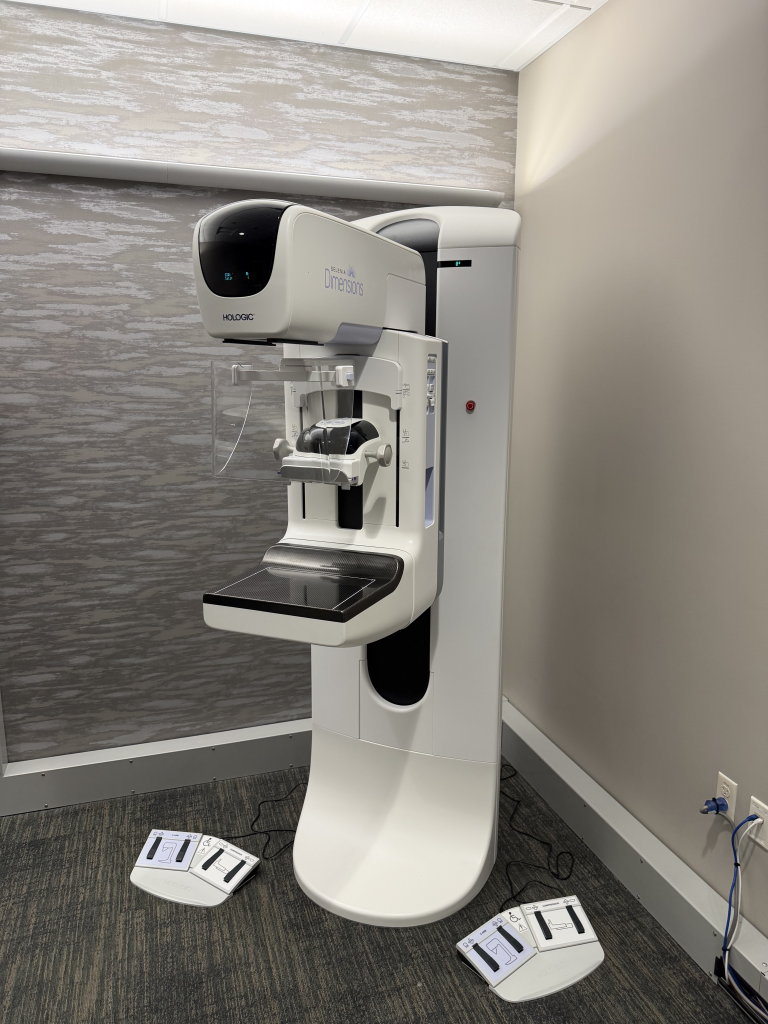
Hegg Health Center has upgraded its diagnostic capabilities, bringing an enhanced 3D mammography system into full operation following official approvals from the American College of Radiology (ACR) and Mammography Quality Standards Act (MQSA).
The new system—a Hologic Selenia Dimensions 3D unit—is designed to improve the screening experience while delivering higher-precision diagnostic imaging. One of the most significant upgrades is a drastic reduction in image acquisition time. Sarah Johnson, Radiology Director at Hegg Health Center, lays out the benefits of the machine.
“It’s a little faster for how long it takes to do the exposure. It used to be about nine seconds and now it’s three point seven. So it’s a lot less time for them to be compressed. It helps to reduce motion on the images when it’s going a little bit faster instead of the possibility of moving in between. Uh, it is, uh, more comfort for the patient.”
Reducing Motion and Call-Backs
By cutting the exposure time by more than half, the technology minimizes blurred images caused by patient movement, reducing the need for repeat scans. Beyond physical comfort, the 3D depth imaging provides critical clarity when evaluating dense breast tissue, where abnormal findings and dense tissue both appear white on standard scans. Johnson compares the new technology to previous methods.
“The technology has really changed, eliminating the unnecessary callbacks where it was unsure if it was just superimposed tissue or something actually needing to follow up with. And 3D is really good for women with denser breast tissue because, anything on a mammogram that is abnormal appears white.”
Local Care Accessibility
Hegg Health Center conducts roughly 600 screening mammograms each year. Having updated, state-of-the-art imaging in Rock Valley keeps critical preventative healthcare close to home, sparing patients a round-trip commute to larger regional hubs like Sioux Falls or Sioux City. Johnson explains the importance of having local access to a 3D mammogram.
“One in eight women will have breast cancer in their lifetime. And we definitely need to keep it local. And so that way patients are more inclined to get it done when it’s an easier thing to get at… versus having to make and plan a whole day around it for going up and traveling.”
In addition to faster exposure times and sharper images, the new equipment can be lowered further to accommodate wheelchair-bound patients. Combined with faster image transfers to radiologists, patient results are processed and delivered far quicker than under previous systems.
Health officials advise women to talk with their insurance providers about establishing a baseline mammogram between ages 35 and 39, followed by regular yearly screening mammograms starting at age 40.