







Northwest Iowa generally missed the heaviest rainfall last week, but wet conditions across much of the state limited fieldwork and slowed the early stages of harvest.
The Iowa Crop Progress and Condition Report for September 14–20 shows just 1.7 days suitable for fieldwork statewide. That compares with 4.9 days during the same week last year.
Four percent of Iowa’s corn and two percent of soybeans had been harvested as of September 20, both behind last year’s pace.
Northwest Iowa Avoids Heaviest Rainfall
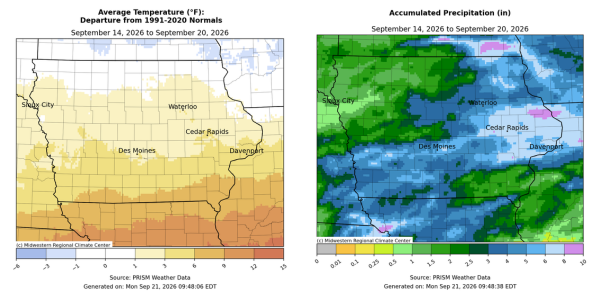
The accompanying precipitation map shows generally lighter rainfall across Northwest Iowa than in the hardest-hit areas of southwestern, central, and eastern Iowa. Milford in Dickinson County recorded just 0.05 inch, the lowest weekly total reported statewide.
Rainfall varied across the region, with the map showing wetter conditions in portions of western Iowa south of the far northwest corner. The temperature map also shows Northwest Iowa generally closer to normal than southern Iowa, where temperatures were considerably warmer than usual.
Statewide, rainfall averaged 3.57 inches, more than four times the weekly normal of 0.83 inch. Ainsworth in Washington County reported the highest weekly total at 10.63 inches.
State Climatologist Justin Glisan said the preliminary statewide rainfall average for the week exceeded the amount Iowa normally receives during the entire month of September.
“An extremely soggy week across much of Iowa made it difficult for farmers to get much fieldwork done, with heavy rainfall leading to flooding in some areas,” Iowa Secretary of Agriculture Mike Naig said in the report released September 21.
Harvest and Crop Development Trail Last Year
Corn maturity reached 56 percent statewide, seven percentage points behind last year. Ninety-five percent of corn had reached the dent stage, one point ahead of last year, while the four percent harvested was three points behind.
Forty-six percent of soybeans were dropping leaves, 12 percentage points behind last year. Soybean harvest, at two percent complete, was two points behind.
Crop condition ratings remained predominantly favorable, with 76 percent of corn and 75 percent of soybeans rated good to excellent. Pastures were rated 70 percent good to excellent.
Topsoil moisture was rated four percent short, 68 percent adequate, and 28 percent surplus. Subsoil moisture was rated two percent very short, 11 percent short, 69 percent adequate, and 18 percent surplus.
Naig said the moisture could help establish cover crops even as farmers wait for fields to dry.
“Conditions are good for flying on cover crops, and the moisture can help get them germinated and growing. When fields finally firm up, Iowa farmers will get combines rolling, and harvest will be fully underway.”