








Northwest Iowa received welcome rainfall last week as several storm systems crossed the region and Iowa recorded its wettest week of the 2026 growing season.
While most northwest Iowa totals remained below the statewide average, the additional moisture followed several weeks of comparatively dry conditions in the region. It also arrived as corn and soybeans continued moving through their later summer development stages.
A precipitation map accompanying the latest Iowa Crop Progress and Condition Report indicates much of Lyon, Sioux, O’Brien and Osceola counties received approximately two-tenths of an inch to one-and-a-half inches between August 10 and 16. Higher totals fell closer to Sioux City and south of the four-county area.
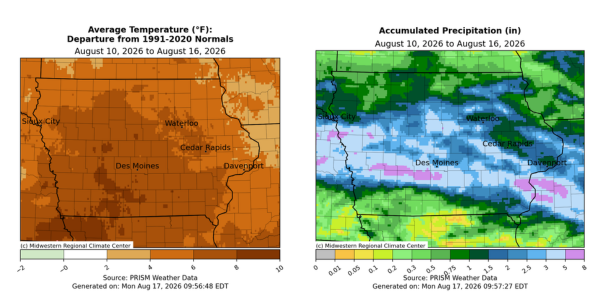
Northwest Iowa Below Statewide Rainfall Average
The statewide average was 2.60 inches—nearly triple the weekly normal of 0.88 inch. Much of central Iowa received between two-and-a-half and five inches, helping drive the state average higher.
Although northwest Iowa did not receive the soaking rainfall recorded elsewhere, the week still brought additional moisture to an area that had remained drier in previous crop reports.
The newest report also includes rainfall that moved through northwest Iowa after the cutoff for the previous week’s report.
“Last week brought widespread rainfall across much of Iowa, including several rounds of thunderstorms and a derecho that developed in eastern Iowa before continuing across parts of the eastern Corn Belt,” Iowa Secretary of Agriculture Mike Naig said.
Weekly rainfall totals ranged from 0.36 inch at New Market in Taylor County to 9.45 inches at Wapello in Louisa County.
Crop Conditions Remain Strong Statewide
Iowa farmers had 3.3 days suitable for fieldwork last week. That was 1.8 fewer days than during the comparable week last year.
The report does not provide separate crop-condition or soil-moisture ratings for northwest Iowa. Statewide, corn and soybean conditions were each rated 78 percent good to excellent.
Corn development remained slightly ahead of last year. Ninety-nine percent of the crop had silked, while 83 percent had reached the dough stage—six percentage points ahead of last year. Twenty-six percent had reached the dent stage, one percentage point ahead of last year.
Ninety-six percent of soybeans were blooming, and 82 percent were setting pods, both even with last year.
Iowa’s oat harvest reached 96 percent complete, six percentage points ahead of last year. Pasture conditions were rated 67 percent good to excellent.
Statewide topsoil moisture was rated 64 percent adequate and 17 percent surplus. Fifteen percent was rated short and four percent very short.
Subsoil moisture was rated 63 percent adequate and 11 percent surplus, while 21 percent remained short and five percent was rated very short.
Because rainfall was not evenly distributed, those statewide moisture ratings may not reflect conditions across far northwest Iowa.
Several Storm Systems Cross Iowa
Multiple storm systems crossed western and northern Iowa during the reporting period.
Thunderstorms expanded across northern Iowa early Tuesday before another line entered western Iowa Wednesday morning.
A broader system covered much of the state Thursday, producing several severe and tornado-warned storms in western and central Iowa. No tornadoes were observed from that system.
Additional thunderstorms developed in west-central Iowa Thursday night and expanded into northern Iowa. The heaviest rainfall, however, generally remained south and east of far northwest Iowa.
The active weather pattern also produced a derecho in eastern Iowa Tuesday. A 75-mile-per-hour wind gust was reported at Independence as the storm strengthened. Two EF-1 tornadoes developed near Greeley in Delaware County, damaging vegetation and outbuildings.
Temperatures remained above normal across northwest Iowa. The report’s temperature map indicates much of the region averaged approximately four to six degrees warmer than normal.
Iowa’s statewide average temperature was 76.7 degrees, or 4.8 degrees above normal. Temperatures ranged from 48 degrees at Greenfield to 95 degrees at Lamoni.