





An Orange City native who helped bring down John Gotti returned home Tuesday evening to share how years of surveillance, informants, and recorded conversations helped federal investigators build their case against the notorious mob boss.
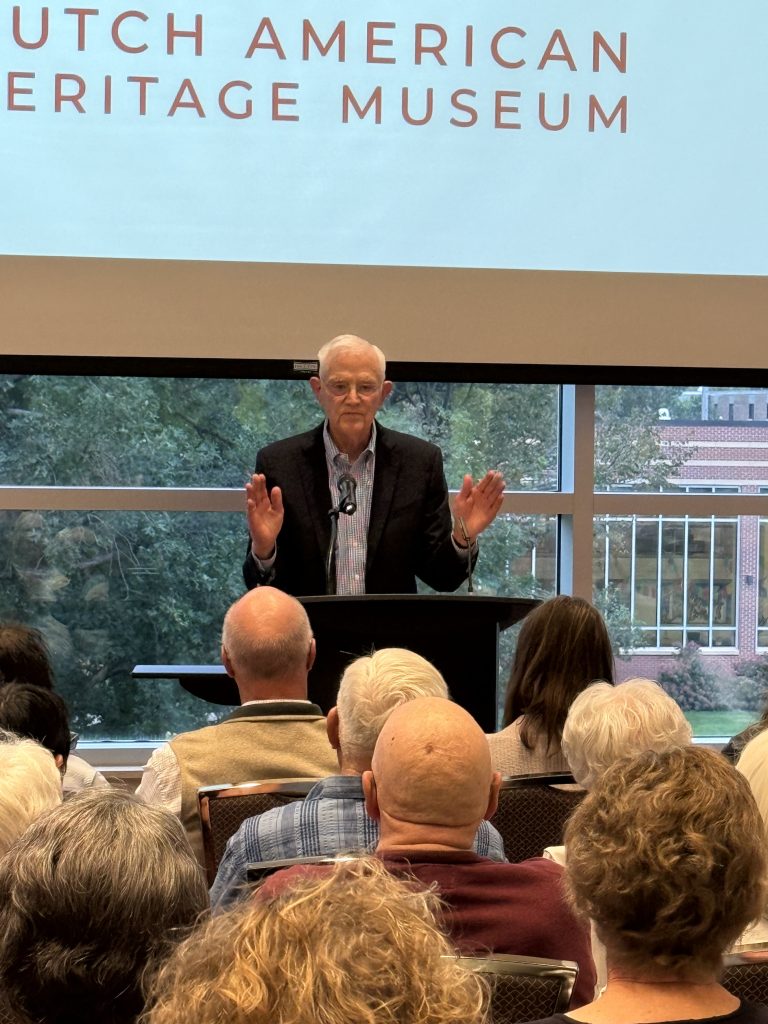
Retired FBI supervisory special agent Bruce Mouw spoke September 29th as part of the Dutch American Heritage Museum’s “Nights at the Museum” series. The program was held at Northwestern College to accommodate the anticipated crowd.
A Hometown Connection and a Lasting Example
Introducing Mouw was Jack Vander Stoep, who spent 21 years with the FBI and now serves as vice president of global security at NetJets. His FBI career included serving on the Joint Terrorism Task Force and spending seven months in a safe house interrogating a terrorist suspect believed to have cooperated with Osama bin Laden.
For Vander Stoep, a 1990 graduate of Northwestern College, the introduction was also an opportunity to thank someone who helped him envision his own future in law enforcement.
“But what really stands out to me most about Bruce is the way he handled a young kid from Orange City from a very young age that would write him, call him, stop by his office in New York City and just ask him how I could become a special agent with the FBI.”
Vander Stoep said Mouw never turned him away and always made time for his questions. That example inspired him to promise he would extend the same kindness to others interested in an FBI career, something he said he continues to do.
Mouw grew up on a farm north of Orange City, graduated from high school in 1961, and attended the U.S. Naval Academy. He served aboard nuclear submarines before beginning an FBI career that included leading the Gambino organized crime squad in New York.
Returning to Iowa remains a pleasure, Mouw told the audience.
“I love coming back to Iowa. You walk down the street, you make eye contact with people. They smile at you. They say hello. Nobody’s honking their horns. And you go into a restaurant, nobody had their cell phone on speaker. And you’re just hard-working people. And I love coming here.”
Building A Case Against Gotti
Mouw described an investigation requiring patience, trusted sources, and agents willing to work through setbacks. Witnesses feared cooperating, and investigators faced suspects familiar with law enforcement’s methods.
“And that’s why these cases, I always say, are the hardest to work, because you’re dealing with career criminals. They’re used to being followed. They’re careful on the phone.”
Agents focused on the Ravenite Social Club in lower Manhattan, where Gotti regularly met with other members of the organization. But an initial attempt to record conversations inside the club hit a practical problem: too much background noise.
Conversations competed with a television and the noise of drink machines. Technicians repositioned microphones and tried additional equipment.
“We brought a special machine in and tried to filter out all the bad noise that didn’t work. And so we had to shut down the bug. You know…holy cow. So that was a disappointing time.”
An informant later helped point investigators toward an upstairs apartment where Gotti and other leaders held private discussions. Agents obtained court authorization and installed a recording device while the resident was away.
Mouw said Gotti’s hearing difficulty helped the surveillance effort. Deaf in one ear, Gotti told Frank LoCascio to turn off a radio intended to mask their conversation, and others had to raise their voices when speaking with him.
A later recording captured Gotti complaining about Sammy “The Bull” Gravano.
“So, John Gotti, for an hour and a half, ranted and raved about Sammy “The Bull” Gravano. And while he was doing that, he detailed five murders they all did together.”
An Investigation Beyond One Mob Boss
Mouw said investigators corroborated the recordings and built the case that led to arrests. Gravano later agreed to cooperate and testified against Gotti, who was convicted on all counts.
But Mouw emphasized that the investigation’s significance extended beyond its most recognizable defendant.
“And the most important thing we did was our target wasn’t really John Gotti. He’s replaceable. Our target was all those guys under him the captains, the big money makers that knew all the union schemes, all the racketeers.”
Gravano’s cooperation helped investigators pursue additional cases against other members of the organization, Mouw said. He also described efforts to remove organized crime’s influence from unions and disrupt the operations that supplied its money.
Mouw, who retired from the FBI in 1998, credited the agents who worked alongside him and told the audience he was proud to have been part of the investigation.
Although retired from the FBI, Mouw continues to work with unions as a monitor.