






Rain slowed Iowa’s harvest during the first full week of November, with farmers getting fewer than two days suitable for fieldwork and corn harvest slipping further behind the five-year average.
The USDA’s latest Iowa Crop Progress and Condition Report shows 72 percent of the state’s corn had been harvested as of November 8, up from 66 percent a week earlier. That six-percentage-point gain left corn harvest 17 points behind the five-year average, compared with a 13-point deficit in the previous report.
Soybean harvest reached 93 percent, up three percentage points from 90 percent the previous week. Soybeans were two points behind the five-year average after matching the average a week earlier.
Farmers had 1.7 days suitable for fieldwork, down from 5.1 days the previous week.
“A wet start to November slowed harvest progress across Iowa, but cooler and drier conditions over the weekend helped get combines rolling again,” said Iowa Secretary of Agriculture Mike Naig. “Soybean harvest is nearing completion, and farmers continue to make steady progress on the remaining corn crop. With a dry week in the forecast, farmers should have a good opportunity to make another strong push toward wrapping up harvest.”
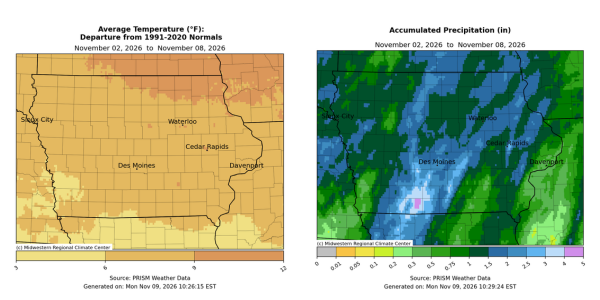
In northwest Iowa, Sioux City Airport recorded the state’s highest temperature of the week, reaching 71 degrees on November 2. That was 17 degrees above normal.
State Climatologist Justin Glisan reported a statewide average temperature of 49.5 degrees, or 7.8 degrees above normal. Northern Iowa had the largest departures above normal.
Statewide precipitation averaged 1.47 inches, more than triple the normal of 0.48 inch. Weekly totals ranged from 0.20 inch in Clinton to 3.50 inches in Mount Ayr. Some locations received more than a typical month’s worth of rain.
The share of Iowa topsoil rated surplus rose to 27 percent from 16 percent the previous week. Another 71 percent was rated adequate, and two percent was short. Subsoil moisture was rated 18 percent surplus, up from 12 percent, with 77 percent adequate and five percent short.
The report covers November 2 through November 8. Harvest and soil moisture figures are statewide.