





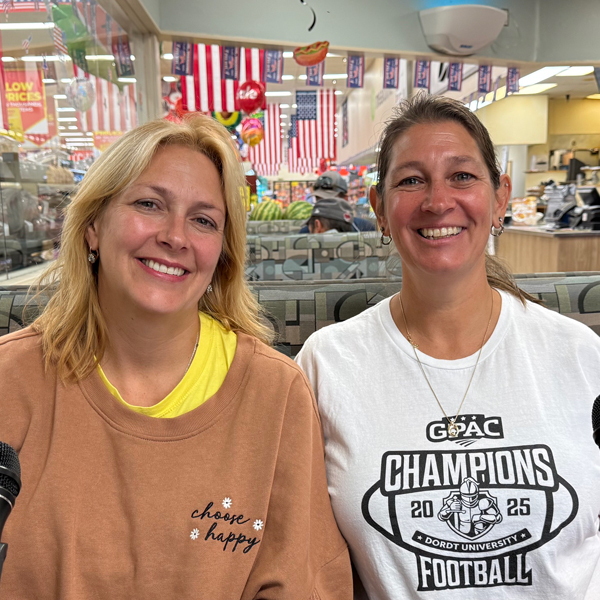
More than four years after Russia’s full-scale invasion of Ukraine, a northwest Iowa native living there says the war has become an open-ended way of life — while her sister says its effects continue to follow families who found safety in Sioux County.
Maranda Heytsi and Martha Hulshof recently discussed the war’s continuing toll during an appearance on The Daily Grind.
Heytsi grew up in northwest Iowa and has lived in Ukraine for about 27 years. She and her husband, who is a pastor, started a church nearly 20 years ago in the western Zakarpattia region near the Romanian border.
“What’s depressing — we don’t see the end. That really gets heavy on your mind,” Heytsi said. “…We’re just living in this season that doesn’t end. It’s like survival season.”
Life in Ukraine Remains Shaped by War
Heytsi said her community is relatively safe compared with areas closer to the fighting. It is separated from eastern Ukraine by mountains and does not have the military facilities or major border crossings that could make it a more likely target.
Still, she emphasized that no part of life in a country at war is entirely safe.
During the first waves of displacement, large numbers of Ukrainians fleeing the east passed through Heytsi’s church. Many stayed, worshiped and served alongside its members before eventually moving elsewhere.
“Everybody that can leave does leave, and everybody tries to leave,” she said. “Pretty much, we just have women, older people, children. … With the men, it’s a huge lack of men right now.”
Heytsi said many men have been drafted, left the country, or gone into hiding amid fears surrounding military recruitment. She said frequently changing rules governing military exemptions have added to the uncertainty.
Meanwhile, the church continues assisting displaced families and others struggling with Ukraine’s wartime economy.
“The focus is just being the Church of God,” Heytsi said. “…The economy is extremely bad right now, and so we’re trying to see those needs and help people. We have a lot of women with children that we help.”
The ministry also continues holding worship services, Sunday school, and youth activities while reaching people who continue to arrive from eastern Ukraine.
Heytsi said she has seen people turn toward God during the war and has heard similar accounts from Christian chaplains serving near the front. She also described the resilience of Ukrainians who have gathered around fires and sung together after attacks left their homes without heat or electricity.
The War Follows Families to Sioux County
Hulshof, an Ireton resident, has helped about 150 Ukrainians relocate to Sioux County since Russia’s invasion began in 2022. That represents the number she has assisted over the course of the war, not necessarily the number currently living in the county.
Hulshof said those families may be working, attending school and participating in their communities here, but their attention remains closely tied to Ukraine.
Asked how local Ukrainians are doing, Hulshof said they are “honestly, very fearful for a few different reasons.”
“We forget as Americans, they all are connected, even though we see them here every day at work and school and all that kind of stuff,” Hulshof said. “…Their families are back home. Their churches are back home.”
She said some stay awake late into the night trying to reach relatives eight hours ahead in Ukraine, uncertain whether a missed message means someone has been injured or killed.
Hulshof also shared that the nephew of one Ukrainian living locally has been missing since June 2025 after serving in a battalion. The family does not know whether he was killed or taken prisoner.
That strain has been compounded by uncertainty surrounding immigration paperwork and employment authorization in the United States. Hulshof said some Ukrainians remain legally in the country but lose the ability to work when their employment authorization expires, or new paperwork is delayed.
Earlier this year, Hulshof said some had already lost jobs because of expired paperwork. She also described one Ukrainian who had initially come to Iowa being detained by ICE in Minneapolis and later released after authorities confirmed the person was legally in the country.
“They’re legal to be here. We forget that they’re legal to be here. Why are we taking away their work authorization?” Hulshof said. “They’re just contributing. They just want to live and contribute and raise their families safely.”
Hulshof encouraged Sioux County residents to ask their Ukrainian neighbors how they are doing and recognize the stress they may be carrying even when their daily lives appear normal.
Prayer and Support
Both sisters encouraged people to contact elected representatives, continue supporting relief work, and pray for Ukraine, refugees living in the United States, and the leaders making decisions that affect them.
“Seriously, pray,” Heytsi said. “…For the protection of the people, that the war would end and the hearts would be changed for the good and not for worse.”